English
 한국어
 français
 Deutsch
 Español
 italiano
 русский
 português
 العربية
 Türkçe
 Polska

PRODUCT DEVELOPMENT JOURNAL / SILICONE LIGHTING
A soft silicone shell is only the visible part of a successful custom night light. The product underneath must combine the right structure, lighting electronics, control system and packaging.
For gift brands, lighting distributors and private-label retailers, developing a custom silicone night light involves more decisions than choosing an animal shape and adding a logo. Silicone wall thickness influences light diffusion. The control mechanism affects user experience. Battery placement determines internal space, while the charging port and packaging influence assembly and shipping requirements.
A reliable silicone night light OEM project therefore begins with a complete product definition rather than a drawing alone. Before committing to new tooling, buyers should decide which functions are essential, which elements can be adapted from existing models, and what must be verified during sample approval.
This guide explains the main engineering and purchasing considerations behind silicone night light customization, using actual OneFire models as product references. It covers mold design, silicone and ABS construction, push-button versus touch controls, LED modules, rechargeable batteries, quality verification and retail packaging.
THE OEM DECISION IN BRIEF
Use an existing product platform when branding, color or packaging changes can meet the project's goals without modifying its main structure.
Consider new tooling when the product requires an original silhouette, different silicone geometry or a redesigned internal structure.
Treat electronic changes separately because touch sensors, batteries, LED boards and charging circuits may require additional design verification and testing.
DESIGN NOTE 01
What Can Actually Be Customized in a Silicone Night Light?
Customization should be divided into three levels. Each level affects cost, development complexity and the type of product approval required.
Level A — Brand and Presentation Changes
For an existing night light, a buyer may request a branded retail box, product label, manual, logo position or alternative color. These are often the first options to investigate because they may preserve the established product structure. However, even a new silicone color or logo application needs approval for appearance, durability and minimum order quantity.
Level B — Product Appearance and Mold Changes
Changing the shape of a dinosaur's tail, adding a new character design or modifying a silicone shell can affect the mold cavity, parting line, wall thickness, demolding method and internal component clearance. Such requests should undergo a design-for-manufacturing review before tooling investment.
Level C — Electronic and Functional Changes
Changing from a mechanical button to tap control, adding a timer, increasing battery capacity or introducing additional lighting modes can require a different circuit board, firmware, sensor or mechanical arrangement. The silicone housing may also need modification to accommodate those changes.
For OEM buyers, these three levels should appear separately in the quotation. A packaging-only change and a completely new silicone night light design should not be treated as equivalent development projects.
DESIGN NOTE 02
How Silicone Mold Design Affects Shape, Texture and Light Diffusion
The silicone shell is both a visible product surface and a functional lighting component. Its geometry determines how the product feels, how the shape is released from its mold and how the internal LEDs appear through the material.
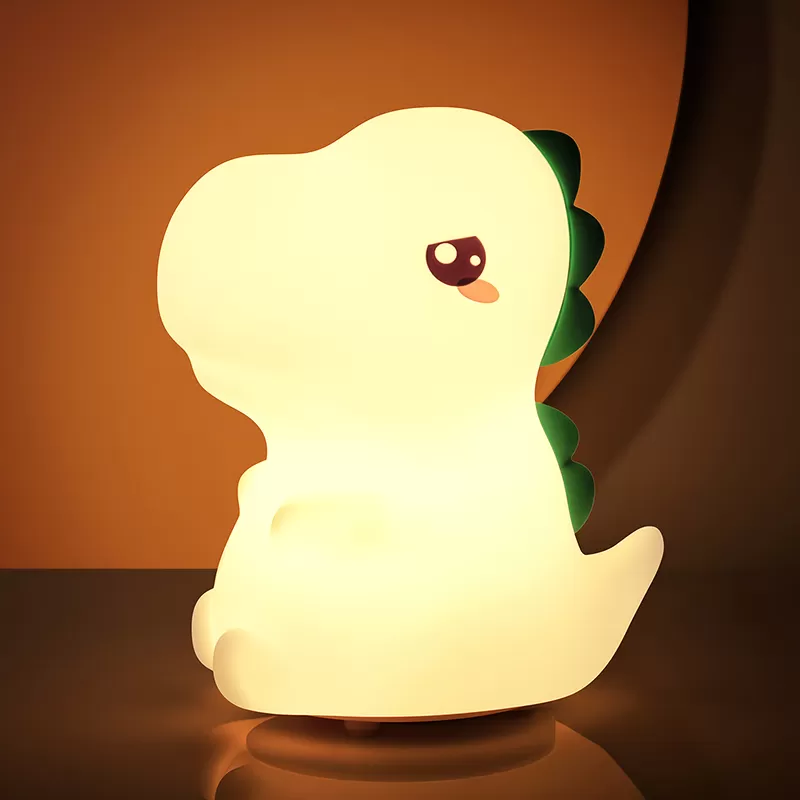
PRODUCT REFERENCE / WH-A27
Soft Shell, Defined Character Details
The WH-A27 Cool Dinosaur Night Light combines a silicone and ABS body with a distinctive dinosaur silhouette. Its tail, facial features and rounded outer surface illustrate why character-shaped lamps require careful attention to mold geometry and light distribution.
Wall Thickness Is an Optical Decision
A silicone shell that is too thin in a particular area may make internal LED points or structural parts visible. Thicker regions may reduce light transmission or make the illuminated surface appear uneven. The required thickness depends on the selected silicone grade, pigmentation, LED position and product geometry.
A design review should therefore evaluate both the unlit surface and the illuminated product. A shell can look uniform in daylight but reveal unwanted bright spots or dark regions when the LEDs are switched on.
Parting Lines, Undercuts and Demolding
Animal ears, small protrusions and detailed facial features can complicate demolding. The mold must accommodate material shrinkage and allow the finished silicone part to be removed without tearing or distorting important features.
A poorly located parting line can remain visible on the front of a character lamp. Unnecessary undercuts may increase tooling complexity, while very thin decorative details may be vulnerable during production or repeated handling.
Surface Texture and Pigment Consistency
Matte and smooth silicone finishes can produce different tactile and visual results. Color pigments also affect light transmission. Buyers should approve both the product's exterior color and the appearance of the light when the lamp is on.
During tooling review, discuss acceptable flash, surface marks, dimensional tolerances and material specifications. These should be recorded in the approved product drawing rather than left to subjective inspection after production.
Engineering reference:Mold design factors such as wall thickness, geometry, mold release and material compatibility are covered in the Formlabs guide to silicone part production. The final mold design must be validated for the selected product and production process.
CONTROL SYSTEM / ENGINEERING NOTE
Push-Button, Tap and Touch Controls: How to Specify the Right System
Control terminology is one of the most common sources of confusion in silicone night light sourcing. A buyer may request a "touch lamp" when the intended function is actually to change modes by tapping or squeezing the soft shell.
These systems are not necessarily interchangeable. They can require different sensors, control logic, mounting positions and verification procedures.
CONTROL TERMINOLOGY MATTERS
"Press," "tap," "touch," and "squeeze" describe different user actions. Before finalizing an OEM specification, define exactly what the user should do and what the lamp should do in response.
Mechanical Push-Button Control
A push-button switch uses a physical actuation point. It offers a defined user action and is common in compact rechargeable lighting products. The switch may be integrated into the plastic base or positioned behind an accessible control area.
The OneFire WH-A28 Sparkle Unicorn and WH-A27 Dinosaur both list a push-button switch, warm light with RGB color options, and two brightness levels for warm lighting. These are concrete product specifications, not assumptions about the entire silicone night light category.
Tap or Impact-Responsive Control
A tap-controlled design can use a motion or impact-sensing approach to detect interaction with the shell. Its performance depends on the sensor arrangement, shell geometry and electronic control logic.
When evaluating such a design, buyers should specify whether a single tap turns the product on, whether repeated taps change colors, and what happens when the lamp is moved accidentally. The product should be tested for both reliable activation and unwanted triggering.
Capacitive Touch Control
A capacitive touch interface senses electrical changes associated with user contact. It may require a dedicated electrode arrangement and controller, along with testing for changes in shell thickness, installation and environmental conditions.
An OEM buyer should not assume that changing from a physical switch to capacitive touch is a simple firmware update. The change may affect the PCB, housing, assembly and development cost.
Practical recommendation: If a brand wants tap, squeeze or capacitive touch control, include the intended interaction sequence in its request for quotation. Ask the supplier to confirm hardware feasibility and sample tests. Do not assume an existing push-button OneFire model already includes these functions.
ELECTRICAL DESIGN / FUNCTIONAL REQUIREMENTS
Battery, LED and Internal Component Layout Considerations
The soft silicone exterior is supported by electronic and structural components. Their arrangement determines charging access, heat distribution, control placement, maintenance requirements and product dimensions.
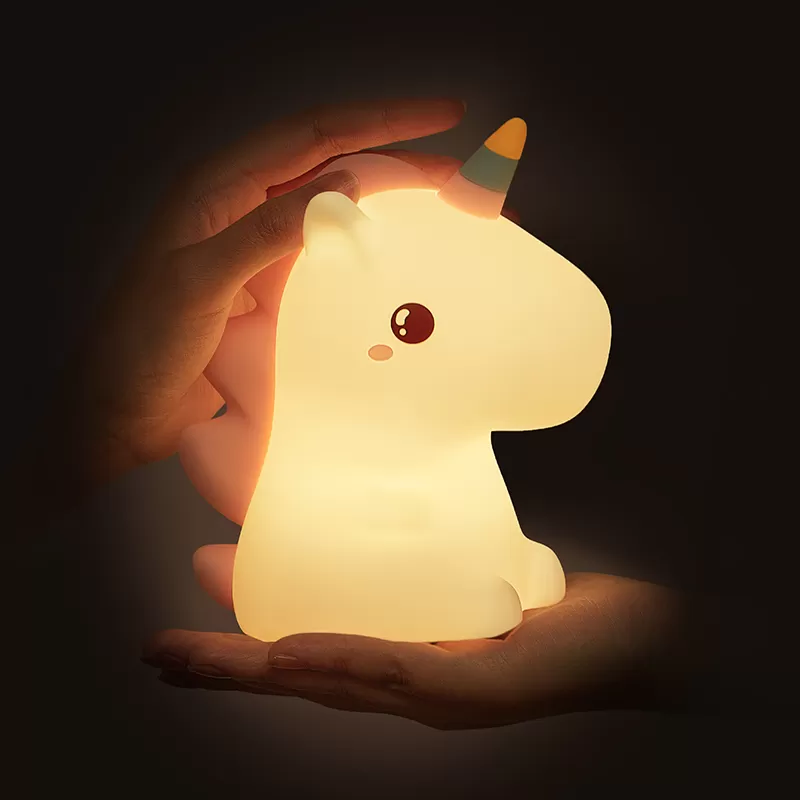
EXISTING PRODUCT PLATFORM / WH-A28
The WH-A28 lists a 1200mAh rechargeable battery, 1W rated power, 5V/1A input and Type-C charging. These values provide a reference for a compact silicone lighting product, but they do not automatically apply to a redesigned OEM version.
Battery Capacity Is Not the Same as Runtime
Battery capacity is commonly expressed in milliamp-hours (mAh). Actual operating time also depends on battery voltage, energy conversion losses, LED power consumption, control electronics and selected brightness level.
Two night lights with the same nominal battery capacity may have different runtimes if one operates in low-brightness warm-light mode and the other uses a brighter RGB setting. For this reason, buyers should request measured runtime under clearly defined test conditions.
LED Placement and Light Uniformity
The position of the LED board affects how light travels through the silicone. If the LED is close to a thin section of the shell, visible hotspots may appear. If decorative features block light, the finished lamp may display uneven brightness.
Warm white and RGB lighting should be evaluated separately. An attractive external design does not guarantee consistent illumination in every lighting mode.
Charging Port and ABS Base Integration
Many OneFire silicone night lights use a silicone and ABS construction with Type-C charging. For a redesigned product, the internal base must provide suitable support for the PCB, charging interface and battery. The selected design should allow practical assembly and access to the required controls.
A charging connector should be easy to access without compromising the product's stability. Port alignment, connector retention and the relationship between the silicone cover and plastic base should be verified during sample evaluation.
Timers, Dimming and Firmware Requirements
Functions such as two-level dimming, continuous dimming, automatic timers and RGB color switching should be specified individually. For example, the WH-A47 Star Rabbit Night Light lists stepless warm-light dimming and a 60-minute timer, whereas WH-A28 lists two-level warm-light brightness adjustment. These differences demonstrate why buyers should define control behavior before modifying an electronic product platform.
DEVELOPMENT RECORD / SAMPLE APPROVAL
From Design Files to Approved Samples: What OEM Buyers Should Check
A new night light design should move through defined approval checkpoints. The purpose is not simply to obtain an attractive prototype, but to establish a reproducible product specification for manufacturing.
REVIEW 01 / DESIGN INTENT
Confirm Appearance, Dimensions and Use
Approve the design drawings, overall dimensions, external color, logo position, user interaction and intended environment. Confirm whether the project is a modification of an existing lamp or a completely new design.
REVIEW 02 / MANUFACTURABILITY
Inspect the Silicone and Internal Structure
Review shell thickness, mold parting lines, openings, internal clearances and material interfaces. Check whether decorative features are practical to mold and assemble.
REVIEW 03 / LIGHT AND CONTROLS
Test the Functional Sample
Evaluate brightness, color modes, control response, timers, charging behavior and runtime under agreed conditions. Confirm that the sample meets the written specification rather than relying on promotional descriptions.
REVIEW 04 / PRODUCTION READINESS
Approve Materials and Quality Criteria
Agree on silicone appearance, acceptable surface defects, assembly fit, functional inspection and applicable product test requirements. Establish how approved specifications will be controlled during production.
REVIEW 05 / COMMERCIAL RELEASE
Sign Off Packaging and Shipment Configuration
Confirm retail artwork, product labels, manuals, accessories, carton quantities and destination-market documents. Keep an approved reference sample for comparison with future production lots.
SAMPLE APPROVAL DELIVERABLES
A practical approval package includes a final model drawing, material and color specification, functional requirements, selected power configuration, packaging artwork, inspection criteria and a signed-off sample. Actual documentation depends on the project and supplier agreement.
QUALITY ENGINEERING / FIELD CHECKS
How to Evaluate Durability and Production Consistency
A sample that looks attractive on a desk may still need improvements before large-scale manufacturing. Silicone night lights combine soft exterior materials with electronic assemblies, so the evaluation plan should consider both.
QUALITY VERIFICATION FILE
Surface and molding: Inspect color consistency, bubbles, flash, surface marks and visible parting lines.
Assembly: Confirm silicone-to-base fit, component alignment, switch accessibility and charging connector position.
Light output: Compare warm-light brightness, RGB color behavior and visible hotspots against the approved sample.
Controls: Evaluate operation over repeated use and check for unintended activation where sensor-based controls are included.
Power system: Verify charging function, applicable battery protection, runtime test conditions and abnormal-operation behavior.
Packaging: Review printed information, protective fit, accessory count and the agreed shipping test criteria.
What About Children's Product Safety?
Many silicone night lights are marketed for bedrooms, nurseries or gifts. Their intended users and marketing claims affect which product standards may apply. Material descriptions such as "soft-touch," "food-grade" or "BPA-free" are not substitutes for evaluating the finished product and its destination-market requirements.
Buyers should determine whether a product is classified as a children's product or toy in the intended market, and assess relevant electrical, battery, mechanical, chemical and labeling obligations accordingly. This article focuses on product engineering rather than replacing an applicable compliance review.
RETAIL PRODUCT DEVELOPMENT
Packaging, Branding and Production Approval
A private-label silicone night light is sold as a complete product, not simply as a molded lamp body. Retail packaging must protect the lamp, communicate the correct specifications and present the brand consistently.

PRODUCT REFERENCE / WH-A47
The WH-A47 Star Rabbit Night Light has a distinctive rabbit-and-star shape, a 1200mAh rechargeable battery and a published minimum customization quantity of 1,000 pieces. Its product details can be used as a starting point when discussing color, packaging and branding requirements, subject to OneFire's confirmation of available options.
Retail Box Design Should Follow Product Configuration
If an OEM model differs from the reference version, its retail box and user manual must be updated accordingly. A carton should not advertise tap control when the supplied model uses a mechanical push-button. Battery capacity and charging information must also match the final configuration.
Artwork and Color Approval
Brand owners should approve logo placement, color references, printed instructions and any intellectual-property artwork. A physical color sample may be necessary because silicone pigments can look different in ambient lighting and under internal LED illumination.
MOQ, Tooling and Commercial Terms
Several existing OneFire silicone night light models list a minimum customization quantity of 1,000 pieces. However, new tooling, electronics modifications, special packaging and custom materials may have different commercial requirements.
A quotation should distinguish unit price from mold cost, prototype expenses, sample charges, packaging development and applicable testing. Buyers should also clarify tooling ownership, revision responsibility and production lead time before approving a new product development project.
OEM BUYER'S DECISION FRAMEWORK
Existing Silicone Night Light or a New Custom Mold?
The decision between modifying a current product and developing an original one should be made according to the actual level of differentiation required.
Option 1: Adapt an Existing Model
Start with a proven product structure when the essential lighting functions are already suitable. The brand may focus on available color choices, external presentation, logo or packaging.
For example, buyers can review OneFire's WH-A27 Dinosaur, WH-A28 Unicorn and WH-A47 Star Rabbit to evaluate different shapes and lighting functions before proposing any modifications.
Option 2: Develop a New Product Platform
New tooling is more appropriate when the intended product cannot be achieved through available designs. This may involve an original character silhouette, new internal layout or a distinctly different interaction system.
In that case, development drawings, engineering feasibility, mold design, functional samples and production approval become a larger part of the project. The buyer should confirm feasibility and commercial terms before assuming any particular modification is available.
For a broader view of currently available models, visit the OneFire silicone night light collection. This product category is the appropriate destination for buyers researching current wholesale models, while this article focuses on OEM development decisions.
ENGINEERING QUESTIONS / OEM DEVELOPMENT
Silicone Night Light OEM FAQs
1. Does every custom silicone night light require a new mold?
No. Brand and packaging changes may be possible with an existing product design. A new mold is generally considered when the shell geometry or important structural features must change. Feasibility depends on the model and requested modifications.
2. What is the difference between push-button and tap-controlled night lights?
Push-button control uses a physical switch. Tap control detects interaction with the lamp, potentially through a motion or impact-sensing system. These functions require different design considerations. OneFire models such as WH-A27 and WH-A28 currently list push-button switches.
3. Can an OEM buyer change the battery capacity of a silicone night light?
A battery change may be possible, but it requires engineering review. A different cell can affect internal space, charging circuitry, thermal behavior, runtime and applicable documentation. The supplier should confirm feasibility and testing before approving the change.
4. How can buyers check whether a silicone shell will glow evenly?
Evaluate a functional sample under consistent lighting conditions. Check for bright LED hotspots, dark areas, inconsistent color and visible internal parts. Shell thickness, pigment, LED placement and optical design all affect the result.
5. What is the minimum order quantity for custom silicone night lights?
Several OneFire silicone night light product pages list 1,000 pieces as the minimum customization quantity. Fully custom molds, revised electronics and special materials may have different MOQ or tooling requirements. Confirm the specific quotation before proceeding.
6. What should a brand approve before mass production?
Approve the final drawing, material and color references, lighting modes, controls, power configuration, sample performance, packaging artwork, inspection criteria and applicable product documentation. A retained reference sample helps confirm the production version matches the agreed specifications.
Final Takeaway: Design the Whole Product, Not Only the Silicone Shape
Successful silicone night light customization depends on coordinating the exterior shell, electronics, user controls and commercial requirements from the beginning. A new character shape may affect mold construction, and a new switch function may affect both the circuit board and the mechanical structure.
For OEM and private-label buyers, the most practical approach is to begin with an existing product platform when it meets the desired requirements, and move to custom tooling only when the benefits justify the added development work.
OneFire's silicone night light collection provides several existing models for evaluating shapes, lighting configurations and packaging specifications. A detailed product brief and properly approved samples are the foundation for any subsequent customization.
CONTINUE YOUR PRODUCT RESEARCH
Explore OneFire Silicone Night Light Designs
Compare the available silicone night light models and review individual product pages for their published dimensions, lighting controls, battery specifications and minimum customization quantities.
For an OEM/ODM development inquiry, share your proposed shape, target quantity, lighting functions, control requirements and packaging concept with the OneFire team.